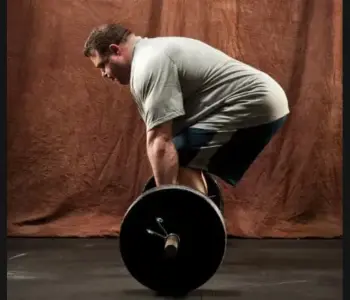
硬舉是提升整體力量的重中之重,它能與其他訓練動作(如深蹲甚至臥推)產生協同效應。它可以增強全身力量、後鏈肌群力量、提高核心穩定性、握力、神經系統力量。然而,硬舉也容易出錯,導致背部甚至二頭肌受傷。讓我們來看看以下全面的硬舉入門指南,幫助你從一開始就掌握正確的硬舉技巧。
Deadlift is the powerhouse that improves your overall strength, synergizing your other exercises like squat and even bench press. It can develop full-body strength, strength posterior chain, increase core stability, grip strength, strength nervous system. However, it is easy to mess it up and injure your back or even biceps. Let’s see the following comprehensive guideline to make your deadlift right at the beginning.
1. 準備/熱身動作 | Preparation/Warm-up
1a. 熱身| Warm-up
動態伸展、輕度有氧運動、多次較輕重量的硬拉
Dynamic stretching, light cardiovascular exercise, Reps of lighter weights of deadlift.
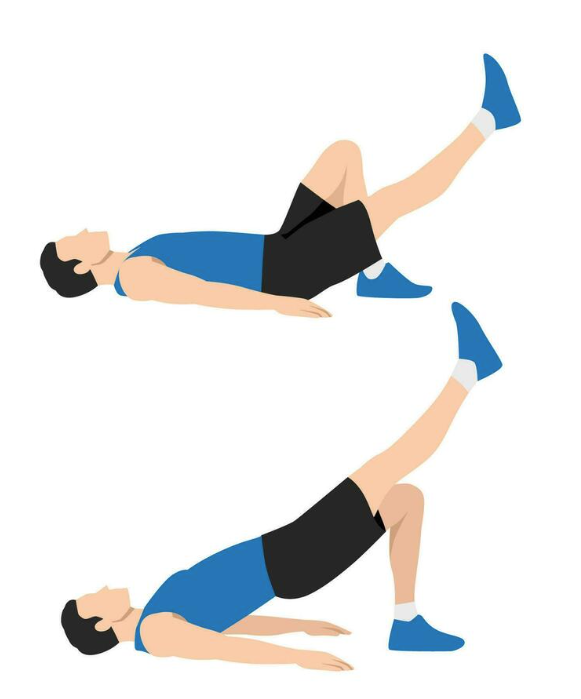
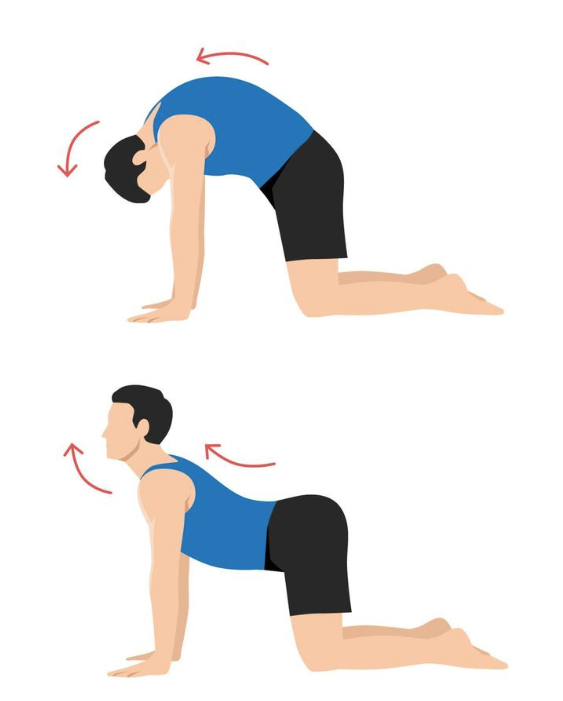
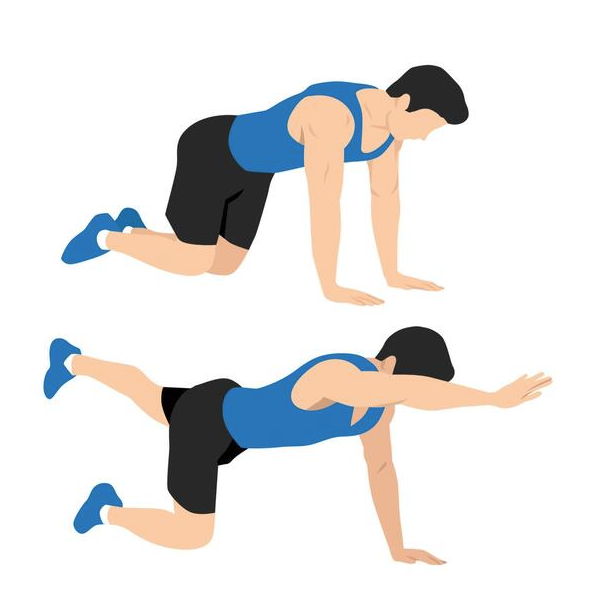
Glutes bridge; Cat-cow; Bird dog
1b. 熱身的好處 | Benefits of Warm-up
提高體溫,促進血液循環,激活肌肉和神經系統,增加關節滑液分泌以潤滑關節。
Increase body temperature, blood flow, activation of muscle and nervous system, synovial fluid in joints for joint lubrication.
2. 步驟 | Step-by-step
2a. 舉重前 | Before you lift
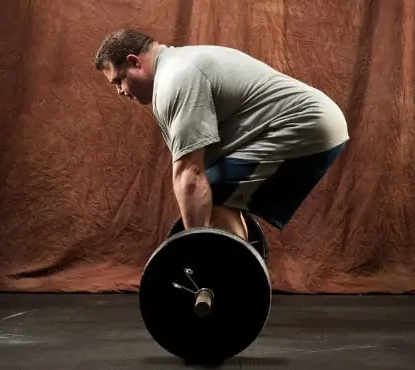
Andy Bolton showing the starting position
- 槓鈴大約位於腳掌中部位置,距離小腿約2.5厘米,當你蹲下時,槓鈴桿會碰到你的小腿。
Bar is about mid-foot and 2.5cm/1 inch away from your shins, then the bar touches your shins when you go down to the bar. - 雙腳站姿略窄於肩寬/臀寬。
Foot stance just inside shoulders width/hip width. - 整隻腳全部著地,即腳跟、第五趾根部和第一趾根部,形成三腳架。
Whole feet on the ground, i.e. heel, base of fifth toe, base of first toe, which act as a tripod. - 雙腳略微外八。
Feet pointing slightly outward. - 收緊臀部,使膝蓋略微向外推。
Engage hips to push your knees slightly outward. - 後三角肌位於槓鈴上方,手臂像鉤子伸直。
Posterior deltoid over the bar, straight arms like a hook. - 雙手好像在「彎曲」槓鈴那樣,收緊三頭肌,鎖定背闊肌,向下向後伸展。
“Bend” the bar, flex triceps and lock your latissimus dorsi, i.e. lats, down and back. - 眼睛要直視前方或略微向下看去繃緊脖子。
Lock you neck by looking straight forward or slight down. - 吸氣時,透過收緊腹斜肌使腹部向兩側擴張,而不僅僅是向前擴張,從而形成360度腹腔內壓力。
Breath in so your core has side lateral expansion by engaging your obliques, not only forward expansion, to make it have a 360 degrees intra-abdominal cavity pressure. - 從頸部、背闊肌、核心肌群、上半身向下延伸至臀部和下半身,去預先繃緊身體,繃緊力量如此之大以至於在開始硬拉之前,槓鈴似乎就已經離地了。
Create/pre-load lots of tension from neck, lats, core, upper body, down to hips and lower body, so much tension that the bar seems lifted off the ground before you initiate deadlift.
2b. 動作分為兩部分(類似下蹲,推)| 2-part of movement (squat-like, push)
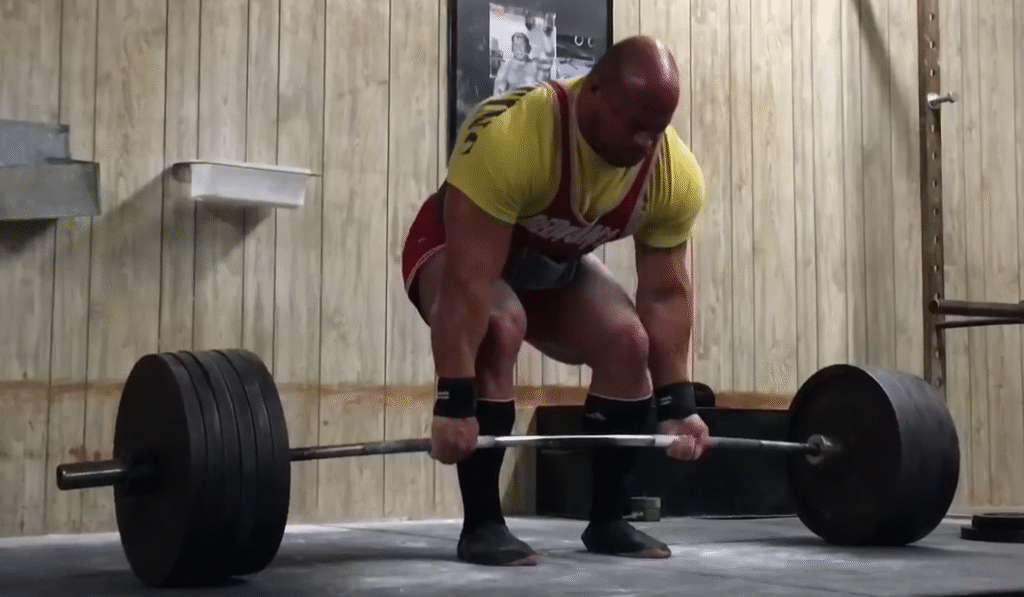
Andrew Hause on leg drive
- 起始位置:臀部溝平分膝蓋到肩膀的距離。
Starting position: crease of hip bisects the distance between knees and shoulders. - 雙腳用力蹬地(腿部發力),就像做腿部推舉一樣。
Push your feet into the ground (leg drive), like doing a leg press. - 胸部和臀部以相同的速度抬起,因此背部相對於地面的角度保持不變。
Chest and hip raise at the same pace, so the back angle relative to the ground remains unchanged. - 膝蓋向後,直到槓鈴到達髕骨尖端下方,即達到羅馬尼亞硬拉(即 RDL)中的膝蓋角度,然後進行 RDL。
Knees back until the bar reaches just beneath the tips of patella and it reaches the knee angle in Romanian Deadlift, i.e. RDL, then perform RDL.
2c. 動作分為兩部分(羅馬尼亞硬舉,拉)| 2-part of movement (Romanian deadlift, pull)
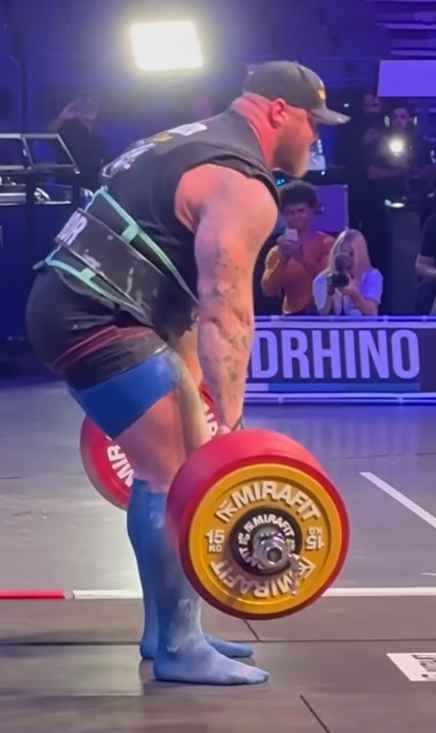
Hafþór Júlíus Björnsson in the midway of deadlift, but due to the heavy weight of the barbell, it is common for them to have little rounded shoulders.
- 臀部向前推,膝蓋繼續向後,背部就會直立,在頂端收緊臀部。
Push hips forward, keep knees backward, back becomes upright and squeeze your glutes at the top. - 在最高點再次吸氣,做好準備迎接離心運動。
Breath in again at the top to brace yourself to prepare for the eccentric movement. - 對於離心運動,進行髖關節鉸鏈運動時,將髖部向後推,膝蓋不要向前,髖部僅作為支點移動。
For eccentric movement, perform hip hinge by pushing hips back, without knees forward, with hip moving as a fulcrum only. - 當槓鈴到達髕骨尖端下方時,膝蓋向前“下蹲”,保持背部與地面的角度不變。
When the bar reaches just beneath the tips of patella, “squat” the way down with knees forward, and keep back angle relative to the floor the same. - 緩慢而平穩的離心運動,不要猛烈撞擊地板。
Slow and smooth eccentric movement, without banging it to the floor.- 點到即止的硬舉,動作要輕柔地觸地。
A touch and go deadlift, which gently touches the ground.
- 點到即止的硬舉,動作要輕柔地觸地。
- 你可以見到下降的動作等於上升的動作。
You can see that the descent is equal to the ascent. - 背部挺直,限制背部活動。
Limit back movement with straight back. - 做羅馬尼亞硬拉時,臀部向後移動,背部屈曲力矩限制了你的背部活動,槓鈴靠近小腿,並且你應該感覺到膕繩肌有輕微的拉扯感。
For the RDL, hips go back, back flexion moment limits your back movement, barbell is close to the the shins, and you should also feel a little bit stretch in hamstrings.
3. 秘訣 | Bonus Tips
- 後三角肌和伸直手臂在槓鈴上方
Posterior deltoid with straight arms over the bar- 以正反握(一手在上,一手在下)站立時,就不會以下手為重心扭轉。
You will not twist from the under grip side as you stand up with mixed grips (one hand over, one hand under).
- 以正反握(一手在上,一手在下)站立時,就不會以下手為重心扭轉。
- 收緊你的肱三頭肌和背闊肌
Flex your triceps and lats- 這樣可以讓槓鈴更靠近你的身體,並垂直移動,從而減輕背部壓力,也更容易完成硬拉動作。
This makes the bar close to your body and moved in straight path vertically, less pressure on your back and easier to complete the lift. - 你可以嘗試用彈力帶放在脖子上,胸部挺起,然後用手向下按壓彈力帶。
You can try using a band on your neck, chest up and pushing down the band by your hand. - 你也可以伸直雙臂向後推背(例如推牆),來運用你的肱三頭肌和背部肌肉。
You can also push back on something in the back (e.g. a wall) with straight arms to feel your triceps and back activation. - 別人可以用彈性帶將槓鈴拉離你,幫助你拉後背闊肌去抵抗槓鈴拉離你的力。
Someone can use the band to pull the bar away from you to help back the lats.
- 這樣可以讓槓鈴更靠近你的身體,並垂直移動,從而減輕背部壓力,也更容易完成硬拉動作。
- 收緊腹部,將肋骨向下拉,同時收緊肩胛骨並繃緊背部肌肉/挺直胸部以平衡這兩個力量。換句話說,這可以防止骨盆後傾,並將槓鈴靠近身體。
Brace in is to contract abs, pull rid cage down, at the same time, retract shoulder blades and tighten back/chest up to balance the 2 forces. In other words, this can prevent posterior pelvic tilt below, and keep the bar close to your body. - 背部屈曲力矩是一種會使脊椎向前彎曲但脊椎本身保持不動的扭轉力。換句話說,脊椎受力,但關節沒有移動。
Back flexion moment which is a torque that tends to bend the spine forward but the spine stays in place. In other words, a force is placed on spine but the joints aren’t moving. - 做羅馬尼亞硬拉時,你可以嘗試用彈力帶進行髖關節鉸鏈練習,或是在下背部放上槓鈴片進行髖關節鉸鏈練習,去感受你的膕繩肌被拉扯的感覺。
For the RDL, you can try banded hip hinge, plate hip hinge on your lower back to practice hip hinge to feel your hamstrings.
4. 向大師學習 | Learn form Masters
Start from 0:43
☕ Buy me a coffeeLast updated on February 19th, 2026 at 11:37 am